Conceptual modeling
Principles of ontology-oriented conceptual modeling
Overview
In the following sections we use the term concept as it is usually used intuitively in conceptual modeling and multi-level modeling (canonical chapter: taoke.de — Multi-Level Modeling), without first clarifying what is meant by it. A fuller formal treatment appears at the end of the original treatise in Formal concepts. At this point it should only be said that the term concept is not equated with the term class.
This chapter discusses the basic principles of conceptual modeling. [GoWi2015a] and [UML] frame the introduction. The basic ideas are first illustrated with a small example ontology about the artist Pablo Picasso. Correct naming of concepts matters: the Semiotic triangle explains how symbols stand for concepts.
Ontological concepts introduces the types of concepts used for ontology modeling, each with graphic symbols and special characters and plain-text prefixes for URLs. OntoGraphs visualize ontologies using those naming conventions. Foundational commitments are discussed in [ArSm2015]; UFO-style perspectives in [GuBe2021] and [Guiz2005].
The next sections cover the main building blocks: Classes organize knowledge subjects into hierarchies and taxonomies; Data properties describe internal structure, while object properties relate subjects. Relational property characteristics spell out the mathematical constraints.
Instantiation explains how models materialize, resting on class hierarchies. Both particulars and classes can be instantiated; the notion of instance is not always used consistently in the literature. Except for horizontal instantiation, particulars do not instantiate other particulars.
Relators are knowledge subjects instantiated through object properties; they connect two or more subjects and behave like first-class citizens alongside classes.
Chains of object properties justify derived relationships.
Relational concept construction builds composite concepts with relational constructors (e.g. (^Air, +°Movement, ^Wind) in the original notation).
Dualism shows alternative models with the same semantics (storage, performance, or style).
Rules add conditional conclusions—unlike simple OP chains, premises must hold before the conclusion applies.
Equations treat formulas as knowledge subjects; see
Pythagorean theorem as an example.
Processes (e.g. ATM withdrawal) map control flow with object properties.
Troponomy hierarchises verbs (°doing, °happening, modal verbs).
[AlHe2020] aligns RDF/OWL practice with this discipline.
Surveys and methodology commentary are in the sibling chapter CM related work (top-level under TAoKE on taoke.de, same as here); in-page anchor: CM related work (on this page).
For deriver.app, triples express subject–predicate–object facts and rules implement IF/THEN behaviour—keep both aligned with the naming and property discipline above.
Multi-level modeling
On taoke.de, Multi-Level Modeling is a top-level TAoKE chapter (alongside Conceptual Modeling and CM Related Work). This mirror keeps the same: the introduction lives under Multi-level modeling (main navigation), not nested under this page’s submenu.
Canonical: taoke.de — Multi-Level Modeling.
Sections in this chapter (mirror)
Local pages mirror the structure of the canonical TAoKE chapter; each page links to the matching section on taoke.de.
- Multi-level modeling (top-level chapter — not a subpage of this list)
- Example knowledge graph (Picasso ontology)
- Semiotic triangle
- Ontological concepts
- OntoGraphs
- Classes
- Data properties
- Object properties
- Relational property characteristics
- Instantiation
- Relators
- Chains of object properties (composition)
- Relational concept construction
- Thematic roles
- Dualism
- Rules
- Equations · Pythagorean theorem (example)
- Processes
- Troponomy
- CM related work (hub — see section above)
Layers of an ontology
The following figure (local copy) illustrates layering as used in the treatise; compare the canonical page on taoke.de for full commentary.
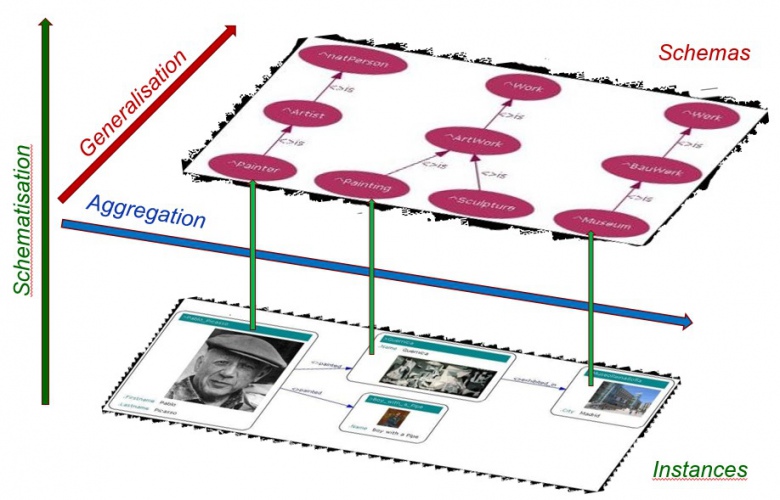
assets/images/ontologies/layers.jpg).Semiotic triangle — Picasso example
The semiotic triangle links symbol, concept, and referent. The worked PDF below is embedded inline (see also the dedicated Semiotic triangle page).
Bliss symbol example
Example Bliss glyph (local asset) for disambiguation and symbolic vocabulary discussion:
Formal Concept Analysis
Where TAoKE discusses attribute implications and concept lattices, the mathematical background is standard Formal Concept Analysis; see [GaWi2024].
Source: taoke.de — Conceptual Modeling.
References
- [AlHe2020] Dean Allemang, Jim Hendler, Fabien Gandon, Semantic Web for the Working Ontologist - Effective Modeling in RDFS and OWL, Third Edition, ACM Books series, Nbr. 33 , 2020, ISBN: 978-1-4503-7614-3
- [ArSm2015] Robert Arp, Barry Smith, Andrew D. Spear, Building Ontologies with Basic Formal Ontology, The MIT Press, London, England , 2015, ISBN: 978-0-262-52781-1
- [GuBe2021] Giancarlo Guizzardi, Alessander Botti Benevides, Claudenir M. Fonseca, Daniele Porello, João Paulo A. Almeida, Tiago Prince Sales, UFO: Unified Foundational Ontology, Applied Ontology 1-3 , 2021, https://www.researchgate.net/publication/355735118_UFO_Unified_Foundational_Ontology, last visit: 09.04.2026
- [Guiz2005] Giancarlo Guizzardi, Ontological Foundations for Structural Conceptual Models, CTIT PhD Thesis Series, No. 05-74, Telematica Instituut, Enschede, The Netherlands , 2005, http://www.inf.ufes.br/~gguizzardi/OFSCM.pdf, last visit: 09.04.2026
- [GaWi2024] Bernhard Ganter, Rudolf Wille, Formal Concept Analysis - Mathematical Foundations, 2nd Edition, Springer Berlin Heidelberg , 2024, ISBN: 978-3-031-63421-5
- [GoWi2015a] Cliff Goddard, Anna Wierzbicka, Global English, Minimal English: Towards better intercultural communication, Symposium: Towards better intercultural communication, Australian National University, Canberra, 2-3 July 2015 , 2015, http://hrc.cass.anu.edu.au/sites/default/files/hrc/u78/Global_English_Minimal_English position papers.pdf, last visit: 09.04.2026
- [UML] OMG, UML: OMG Unified Modeling Language (OMG UML), Infrastructure, V2.1.2, Date: November 2007, https://www.omg.org/spec/UML/2.1.2/Infrastructure/PDF/, last visit: 09.04.2026